
"Doctor, can you take all of this out?" That is often the first thing people say when they sit down. I usually answer with a question: what bothers you most? Is it the small lump that keeps hurting, the ridge you can see in the mirror, or a whole cheek that looks too full? All three get called "filler problems," but where treatment should stop is very different for each.
Seeing the material that has been removed can feel like the problem finally has an answer. But what you see in the mirror every day afterward is not that material. It is the tissue and contour that remain. How much comes out and how big the wound is are fair questions. If no one has also thought about whether the discomfort will improve, which normal tissue should stay and whether the treated area will blend with its surroundings, only half the decision has been made.
Agree on what this treatment is meant to improve
Pain can improve without all the material being cleared. A smoother look does not mean the painful spot has been dealt with. So it helps to set one main goal for symptoms and one for appearance, then check both at follow-up. That is the only way to know what this treatment actually achieved.
I won’t promise to get everything out. Filler can grow into the surrounding tissue, spread to different places, or have already been dissolved or injected with steroids. What can be treated safely is not necessarily everything visible on imaging, and it is never everything that was originally injected. When I say I’ll "clear it out," I mean improving it as much as is safe, not removing every last particle. The FDA also notes that reducing or removing filler may call for different approaches, and that some materials are difficult or impossible to remove, so permanent or non-HA fillers need especially careful discussion. FDA information on filler removal https://www.fda.gov/medical-devices/aesthetic-cosmetic-devices/dermal-fillers-soft-tissue-fillers
When you hear a percentage, ask what it is measured against
The next question is usually, "How much can you remove?" My answer is that the first session usually takes out about 30 to 50 percent. With a typical filler, two to three sessions can usually remove about 80 to 90 percent, with about three months between sessions. How many sessions you need varies with the amount of filler, the degree of fibrosis and whether it has migrated, and it will not be 100 percent.
So treat the 30 to 50 percent and 80 to 90 percent I just gave as a rough guide; the point is to understand why removal is staged. Whoever gives you a percentage, ask what it is measured against. The amount originally injected, the amount still present, the extent seen on imaging and the weight of tissue removed during the procedure are four different things. Use one in place of another and the number looks precise while missing what you actually care about: what your face will look like, and whether it will still hurt.
More than a percentage, I want the boundaries agreed before treatment: which area we treat this time and which areas we leave alone. If some material is going to stay, is that to protect nearby tissue, to avoid a step-off in the contour, or because the diagnosis is not settled yet? Agreed in advance, leaving material behind or treating in stages is part of the plan, not a surprise that turns up afterward.
There are also situations where I usually suggest not treating yet: the tissue is still reacting after the injection and is still changing; the asymmetry is mild and the amount small; the filler is spread widely with very little in any one place; or the hope is to get back the face you had before the injections. Removal takes out material. It does not rewind the changes your tissue has gone through over the years.
The material and the lesion decide which options are worth comparing
HA, other fillers and inflammation in the surrounding tissue each call for a different approach. If there is still HA suitable for treatment, hyaluronidase may still have a role. If inflammation or another lesion is the main issue, treatment has to go back to that cause. Having had several rounds of hyaluronidase, or one medicine that didn’t help, does not mean every nonsurgical option has been tried. Consensus on delayed HA reactions https://pubmed.ncbi.nlm.nih.gov/32440404/ For the same reason, I won’t tell anyone whether their filler can or cannot be removed until I have seen it on ultrasound.
Two procedures may both be called removal and still deal with very different things. A single, well-defined lump and a broad area crossing several tissue layers differ in where to enter, how large an area to treat and how the tissue needs to be separated. When you compare plans, look at what is actually being treated. A procedure name or one after photo can’t tell you that.
Some situations can be watched first. Watching is not open-ended waiting. Record how things look now, agree on what to monitor and which changes mean coming back sooner. On the other hand, an infection or another acute problem has to be dealt with first, not slotted into a routine cosmetic schedule.
The table below does not rank these routes from weak to strong, and it does not mean surgery is the inevitable last step. They may be combined in sequence, or only one may fit. Whichever route is chosen, the reason should trace back to a problem that has been confirmed.
Table 1. This compares the question each route answers, not how well it works. Whether a route applies depends on the material and the diagnosis.
| Possible route | Main question it answers | What should not be assumed |
|---|---|---|
| Planned observation | Is it stable, and which changes would call for treatment? | Everything will disappear if you wait long enough |
| Appropriate HA-directed treatment | Is there still HA that can be targeted? | Every material and tissue change can be dissolved |
| Treatment aimed at inflammation or another cause | Where are the symptoms mainly coming from? | Symptom relief means the material has been cleared |
| Selective extraction or other surgery | How can the local target be treated while preserving surrounding tissue? | A small wound (a pinhole) means everything is cleared, no scar or no risk |
The pinhole is small, but the work underneath is still extraction
Our extraction is ultrasound-guided. On the skin there is only a pinhole of about 2 mm, with no incision and no stitches. Larger areas are treated in sections or in stages, still through pinholes. But a small pinhole does not mean a small treatment area underneath. This is extraction, so swelling and bruising will happen. They usually fade in about two to three weeks. The pinhole heals in about two weeks and fades over about two months, and it takes about three months overall to see the final result. Everyone heals differently. We never describe the recovery as short.
Risks should be discussed in terms of the site, the depth and the actual technique: bleeding, hematoma, infection and wound healing, as well as scarring, changes in sensation, nerve or blood vessel injury, and new asymmetry or unevenness. Ultrasound lets me see where the material is and how close it sits to vessels and nerves, but a boundary on the screen is not a line that can be followed without risk. The words "minimally invasive" do not replace that conversation.
One study followed patients who had permanent filler removed together with a facelift and recorded infection, contour irregularities and neurovascular complications. That surgery is more extensive than a localized revision, so its complication rates cannot be applied to every kind of removal. Its reminder is still right: revision is a procedure too, and the fact that it is corrective does not mean the risks deserve less discussion. Permanent filler removal with facelift study https://pmc.ncbi.nlm.nih.gov/articles/PMC9467677/
Pain, sensation and how your face moves are part of the outcome too. If a problem that used to be purely cosmetic is replaced by ongoing discomfort, a smoother photo does not make it a good result. So current symptoms should be recorded before treatment, and follow-up should involve more than before-and-after photos.
Look at the contour that will remain before treatment, not after
Quite a few of the patients I see had filler removed elsewhere and were left uneven. Having had it removed is not the same as having it cleared, and still less the same as having it left smooth.
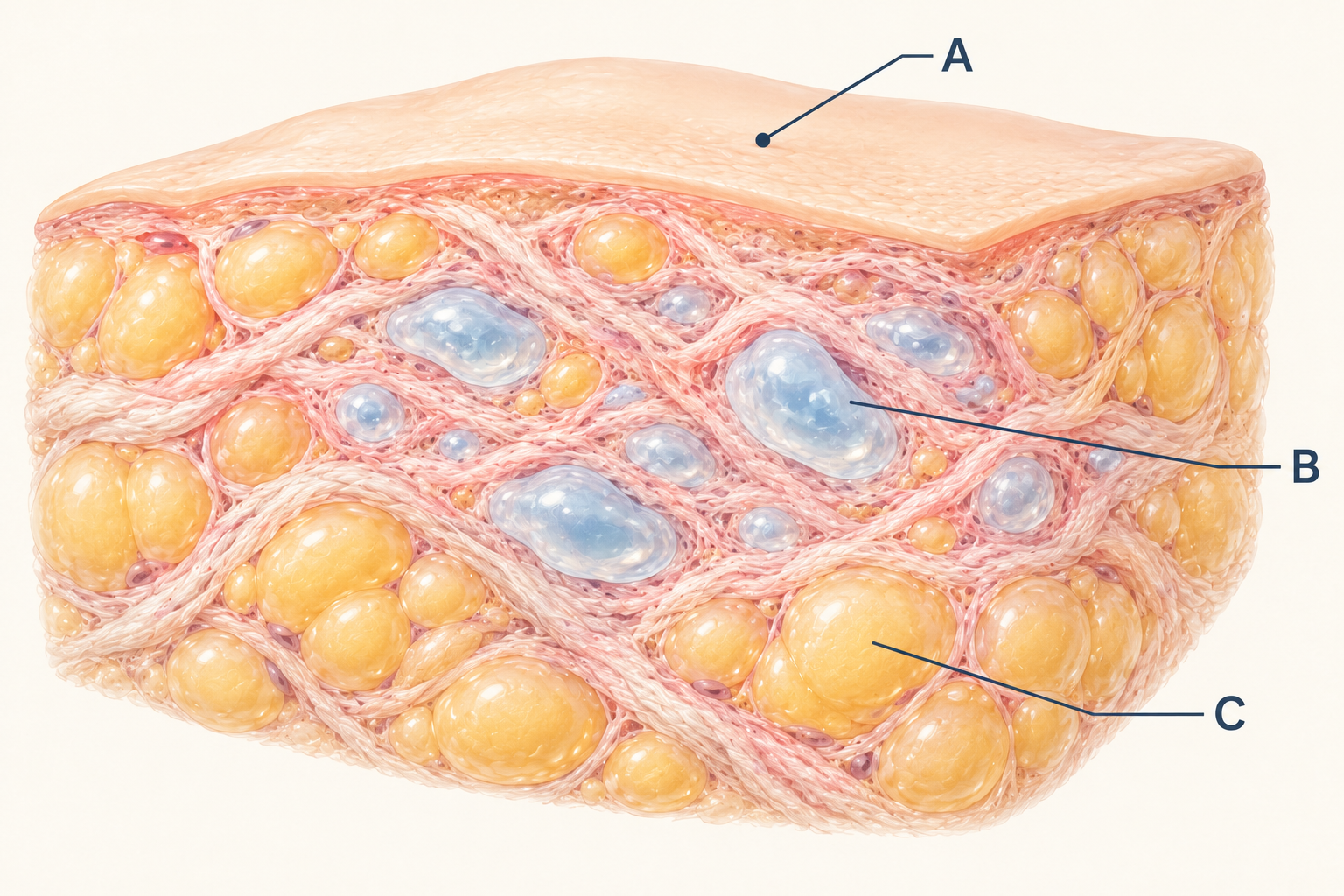
As a bump gets smaller, a hollow that the filler was propping up may become more obvious, and existing asymmetry or laxity may be easier to see. Not everyone develops a new depression, but this is why I don’t focus on that one bump. Before treatment I look at the whole face: how the area meets its neighbors, what the filler was originally meant to correct, and how the filler is pulled when you change expression.
I judge removal and injection by the same aesthetic standard: a balanced overall contour in proper proportion. An overfilled area does not need to be emptied completely. I remove only what protrudes and follow your natural lines so that what remains is smooth and even. Open surgery cuts out a whole block and can easily leave a local hollow. Through a pinhole, I can take out just the part that sticks out.
The literature points the same way. A surgical series of 231 permanent-filler cases planned material removal and aesthetic restoration together. It does not mean everyone needs a facelift or fat grafting, nor does it show that one operation is better than another. What it shows is that what to remove, and what the area will look like afterward, need to be planned together. Study of surgical pathways for permanent filler removal https://pubmed.ncbi.nlm.nih.gov/36696919/
Staging is about seeing the next step more clearly
If I recommend staged treatment, the first session has a clear purpose, such as dealing with the main problem area first. After about three months, once the swelling has gone down and the tissue has settled, another ultrasound shows how much is left and where, and then we decide on the next step. Some people are happy after the first session, or feel the remaining amount isn’t worth another round of swelling. Then there is no need to continue. Whether to have a second session depends on the ultrasound and on how you feel about the result.
When comparing two plans, measure them against the same goal: how much of your concern each is expected to improve, what might remain, which risks it adds and how much aftercare it involves. If a plan offers to remove more but does not explain what that costs in normal tissue and contour, the information is still incomplete.
Understand the whole plan before you decide
Only then fit the plan into daily life: the type of anesthesia, whether someone needs to come with you, wound care, where follow-up takes place, who to contact outside clinic hours, and how tests, medicines and any additional treatment are charged. Returning to work, getting back to exercise, bruising fading and the contour settling are different milestones. Avoid alcohol for about a week after treatment; seafood and spicy food don’t need to be avoided. For more on recovery, read the recovery article in this series.
If anything is still unclear, bring your records and talk it through again. If the situation is not urgent, a second opinion is a good idea too. The UK’s NHS guidance also encourages people to understand the procedure, aftercare, risks and costs, and to give themselves time to decide. Consultation guidance https://www.nhs.uk/tests-and-treatments/cosmetic-procedures/advice/choosing-who-will-do-your-procedure/ Being ready for revision means more than knowing removal is planned. It means understanding why the area will be treated this way, what will be left alone and how you will judge whether the goal has been met.
Explore the filler revision assessment process and risks to discuss https://www.minimalcutsurgery.com/en/services/repair/filler
References and evidence context
[1] U.S. FDA. Dermal Fillers (Soft Tissue Fillers). https://www.fda.gov/medical-devices/aesthetic-cosmetic-devices/dermal-fillers-soft-tissue-fillers
Official information on removal limitations and emergency warning signs. U.S. approval is not approval in other jurisdictions.
[2] Philipp-Dormston et al. 2020. Global Approaches to the Prevention and Management of Delayed-onset Adverse Reactions with Hyaluronic Acid-based Fillers. https://pubmed.ncbi.nlm.nih.gov/32440404/
Expert consensus on delayed HA reactions; individualized assessment, not a protocol for every biostimulator.
[3] Facelift Surgery after Permanent Filler: Outcomes after Removal of Permanent Filler under Local Anesthesia. 2022. https://pmc.ncbi.nlm.nih.gov/articles/PMC9467677/
Case series of permanent filler removal combined with facelift; informs risk categories and procedure differences, not transferable complication rates or recovery periods.
[4] Pascali et al. Aesthetic Surgical Pathway in Permanent Facial Filler Removal. 2024; published online 2023. https://pubmed.ncbi.nlm.nih.gov/36696919/
Surgical series of 231 permanent-filler cases addressing removal and aesthetic restoration; not a comparative trial covering every material or localized technique.
[5] NHS. Choosing who will do your cosmetic procedure. https://www.nhs.uk/tests-and-treatments/cosmetic-procedures/advice/choosing-who-will-do-your-procedure/
Official patient guidance on procedures, aftercare, risks, costs and time to decide.
Dr. Ta-Ju Liu
