Hollowing risk and the trade-offs of staged revision
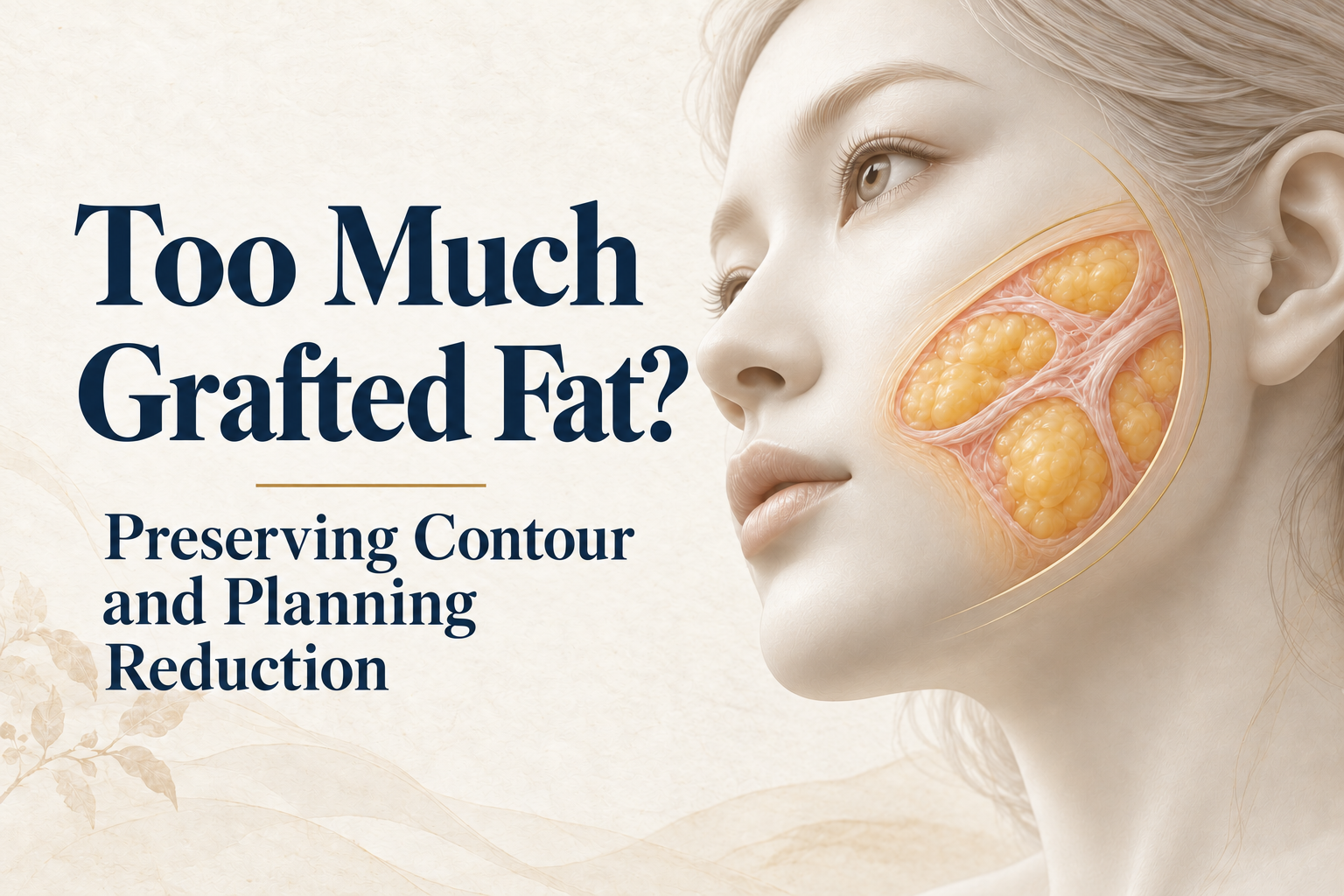
"Did I get too much? Can some of it come out?" People who come in after facial fat grafting usually bring these two questions, often because the face looks too round from the front, or a ridge bunches up under the eye when they smile. Yet the same face may not be equally full everywhere in profile, and the ridge looks less obvious when they aren’t smiling.
How much can be removed is a fair question. What I care about more is where to remove, what to leave, and whether the two areas will blend. Taking out the same volume might soften a prominence, or it might make a hollow next to it more visible. So I start a reduction discussion with the whole stretch of contour, not by picking a device and asking what percentage it can remove.
I think of fat reduction as precise fat grafting done in reverse. When grafting, you work out how much each area needs and how it joins the next one. Reduction is the same work in the opposite direction. I do liposuction and fat grafting, and I have also repaired liposuction that went wrong. Much of my feel for leaving an even surface comes from that work.
Facial fat sits in compartments
Facial fat is not one even cushion running from under the eye to the jaw. Rohrich and Pessa’s anatomical research found that subcutaneous fat is divided into several regions with boundaries between them. It is an anatomy study, not evidence about reduction outcomes. In the clinic, it means that when one area gains volume, loses it or shifts, I have to look at it together with its neighbors. Reference: facial fat-compartment anatomy https://pubmed.ncbi.nlm.nih.gov/17519724/ That is why reduction is not a matter of thinning wherever something bulges.
When someone points and says "it sticks out here," two things are usually going on: the prominence itself, and the contrast created by a hollow beside it. If it only bulges when you smile, I also need to know whether that is grafted volume or your own muscle and ligament structure, and that takes ultrasound to see the position and layers. So I look from the front, at an angle and in profile, at rest and during expression. The brightest patch in a photo is not a map of everything that should be treated.
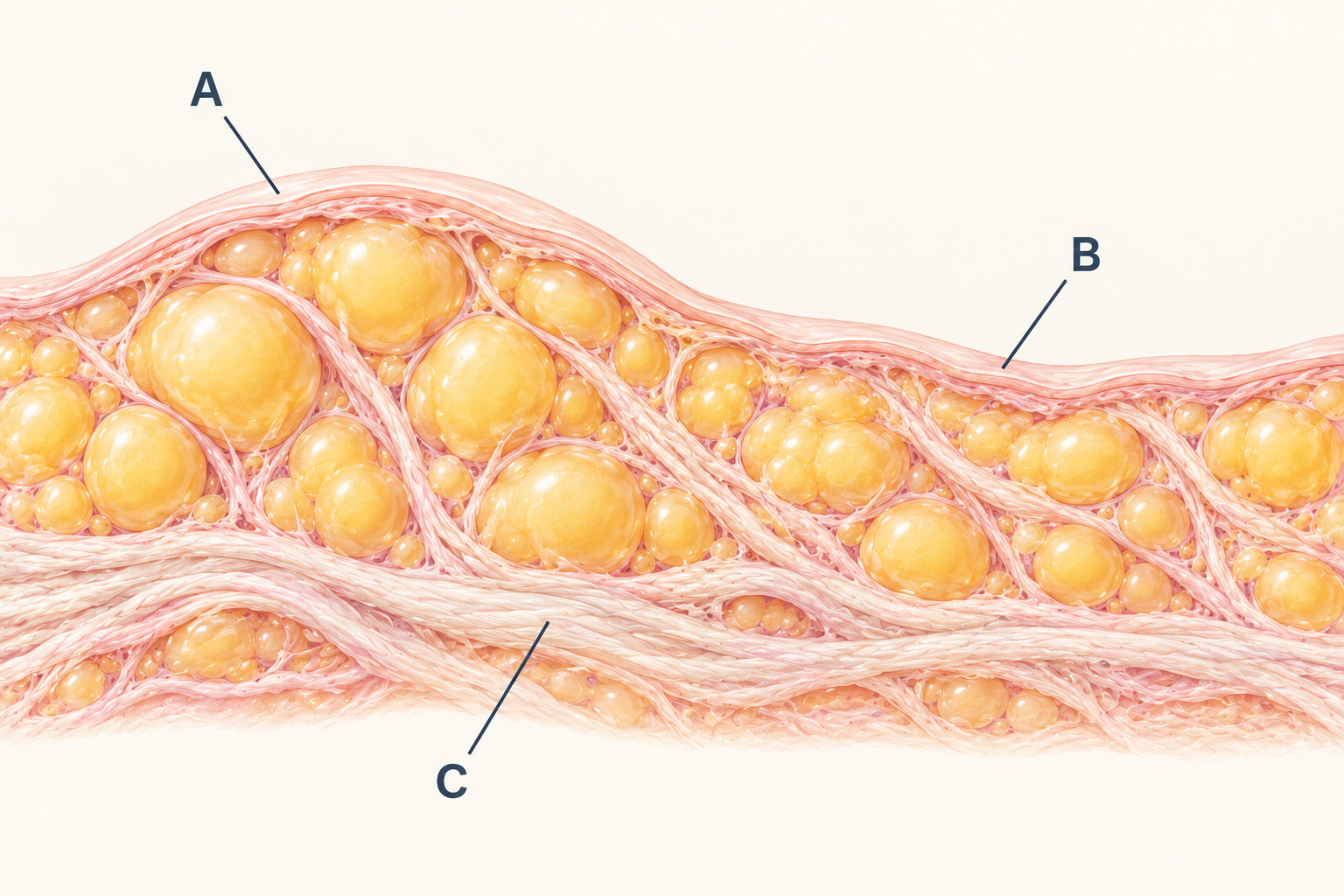
In the illustration, look at the edges of the prominence as well as its center. The hard part of revision is often making treated and untreated areas meet smoothly, not making one spot as thin as possible. The drawing explains a way of thinking. It cannot be used to decide how deep or how wide anyone’s treatment should be.
Work out where the fullness comes from
Early swelling, surviving fat, an oil cyst or lipogranuloma, and fibrous tissue can all change how the area looks and feels, and often more than one is present. Animal tissue studies have also shown that grafted fat can survive, regenerate, scar or form oil cysts. That does not mean every graft goes through the same steps in the same order. Reference: fat-graft tissue remodeling https://pubmed.ncbi.nlm.nih.gov/24572875/
In fat-graft revision, the hard part is often recognizing the problem, not removing it. The boundary between grafted fat and your own tissue is often unclear, so I rely on differences in how they appear on ultrasound, and on whether there is a capsule or an oil cyst, to tell what needs treating. Different sources mean different targets. Too much surviving fat is a question of volume and distribution. A symptomatic lesion also raises questions about what it contains, how the surrounding tissue is reacting and what the diagnosis is. Less volume does not mean the inflammation has settled, and whatever shrinks an inflamed nodule may not be a way to reshape a broad area of living fat.
Table 1. Turning "how it looks" into questions for assessment. This is a communication aid, not a self-diagnosis or procedure-selection tool.
| What you notice | What still needs clarifying | How to describe the goal |
|---|---|---|
| A broad area looks thick or full | How much is swelling, fat volume, distribution or your original face shape? | Name the contour you want adjusted and the fullness you want to keep. |
| A single lump or ridge | Is there a cystic component, inflammation or fibrosis? Are there symptoms? | Define the lesion first; don’t let thinning a whole area stand in for a diagnosis. |
| A bulge next to a hollow | Was the hollow there before? How will the two areas meet after the bulge is treated? | Assess neighboring highs and lows together, not just the height of the bulge. |
| It shows mainly with expression | Where does the change between rest and movement happen? What has been done before? | Record a repeatable expression rather than comparing two photos with different expressions. |
Ultrasound helps locate the area and gives some clues about what it contains, but it can’t calculate how much should come out at the press of a button. If things are still changing, or the cause isn’t clear yet, getting the diagnosis and follow-up right can matter more than reducing straight away.
Removing less does not solve the fear of hollowing
A fear of hollowing can cover several different situations: the treated area doesn’t blend with its surroundings; a volume deficit that was already there becomes easier to see; or the condition of the skin and soft tissue makes the result look different from what you pictured. Not every hollow comes from removing too much, and removing less does not mean it won’t happen. The real cause takes an assessment to find.
If the same area has already been injected, suctioned or operated on more than once, I ask one more question: is the bulge I’m looking at untreated volume, or tissue change left behind by earlier treatment? The next step is different for each. So what was done before, and where, is not a line of background in your records for me. It changes the plan.
The options fall into three broad directions: no treatment for now, with follow-up; treatment aimed at clearly identified inflammation or a localized lesion; and contour reduction once it is confirmed to be suitable. They can happen one after another and are not mutually exclusive. A study of periorbital lipogranulomas recorded improvement with observation or local steroid injections, but that is not evidence for reducing excess living fat, and it is not a general reduction prescription. Reference: periorbital lipogranuloma series https://pmc.ncbi.nlm.nih.gov/articles/PMC4742640/
We reduce fat grafts through ultrasound-guided extraction via a pinhole of about 2 mm, with no incision and no stitches. Even so, a pinhole, imaging guidance or any particular device describes only how the area is reached and treated. None of them means no scar, no risk to nerves and vessels, or an even result for certain. Once the method is set, we still need to talk about infection, bleeding, changes in sensation, injury to nearby tissue and new asymmetry or unevenness. The American Society of Plastic Surgeons’ liposuction information is a starting point for that discussion, but it is not our clinic’s risk rate or a risk estimate for facial revision. Reference: ASPS liposuction risks https://www.plasticsurgery.org/cosmetic-procedures/liposuction/safety
When you hear a percentage, ask what it is a percentage of
If someone describes reduction as a percentage, first ask what it is a percentage of: the amount originally injected, the current volume of one area, or the amount of fat removed during the procedure? Then ask what area was measured, how and when. Without those details, a percentage alone still won’t tell you how your contour will change.
The survival rate of the original fat graft says even less about how much a revision can remove. Survival rate describes how much transferred fat stayed. A revision has to define which tissue is being treated, over what area, and with what result. Even with a volume measurement, pain, how it feels to the touch, how natural your expressions look and how satisfied you are need to be assessed separately.
The goal I would rather hear is "trim down this one prominence and keep the soft fullness next to it," not "take out half, no matter what." I judge removal and grafting by the same standard: a balanced overall contour in proper proportion. An overfilled area does not need to be emptied completely. I remove only what protrudes and follow your natural lines so that what remains is smooth and even. That is still not a promise of a result, but at least we are discussing the same question.
Staging needs a specific reason
When both a focal lesion and the overall contour need attention, or earlier treatment is still clouding the picture, I tend to deal with the clearest problem first and then see what is left. The point is to base the next step on new findings. Taking a little less each time does not by itself make the final result look natural.
A clear staged plan explains how far the first session goes, which areas are deliberately left alone and what the next assessment needs to answer. Have the symptoms improved? How much volume is left? How should the existing hollow be read? After pinhole extraction, swelling and bruising take about two to three weeks to fade, and the final result takes about three months. So I decide on the next session once the tissue has settled and the ultrasound is clear. Whether any area needs volume added back after reduction is also discussed at a follow-up visit once things have settled.
Staging has costs too: another recovery period, more follow-up visits, expense and added risk. It is not necessarily better than a single session, and a second session is not mandatory. If the result after the first session is acceptable, or the next step carries more risk than likely benefit, stopping is part of the plan.
Before the consultation ends, aim to leave with three clear answers: which stretch of contour you actually want changed, which tissue should stay, and what would mean leaving things alone for now. Dated front, side and expression photos, together with records of previous treatment, keep the discussion on your own face rather than circling around fat volumes and device names.
If you are considering reduction after fat grafting, start with the information on fat-graft revision and how it is assessed. Bringing both what you want improved and what you want kept makes it easier to reach a concrete plan than asking only whether it can all come out.
Explore fat-revision options and contour assessment https://www.minimalcutsurgery.com/en/services/repair/fat-graft
References and evidence context
[1] Rohrich RJ, Pessa JE. The fat compartments of the face: anatomy and clinical implications for cosmetic surgery. Plast Reconstr Surg. 2007;119:2219–2227. https://pubmed.ncbi.nlm.nih.gov/17519724/
Dissection of 30 hemifaces supports distinct subcutaneous fat compartments. It is not a comparison of reduction procedures or their outcomes.
[2] Kato H, et al. Degeneration, regeneration, and cicatrization after fat grafting. Plast Reconstr Surg. 2014;133:303e–313e. https://pubmed.ncbi.nlm.nih.gov/24572875/
Mouse histology supports different tissue outcomes within a fat graft, not a human revision timetable or treatment effect.
[3] Park JY, Kim N. Periorbital Lipogranuloma after Facial Autologous Fat Injection and Its Treatment Outcomes. Korean J Ophthalmol. 2016;30:10–16. https://pmc.ncbi.nlm.nih.gov/articles/PMC4742640/
A nonrandomized series of 27 periorbital lipogranulomas, with histology in only 3. Observation and injection responses cannot be generalized to all fat-related concerns.
[4] American Society of Plastic Surgeons. Liposuction Risks and Safety. https://www.plasticsurgery.org/cosmetic-procedures/liposuction/safety
General liposuction risk information, not complication rates for facial fat-graft revision or outcomes at any clinic.
Dr. Ta-Ju Liu
