Key Highlights
-
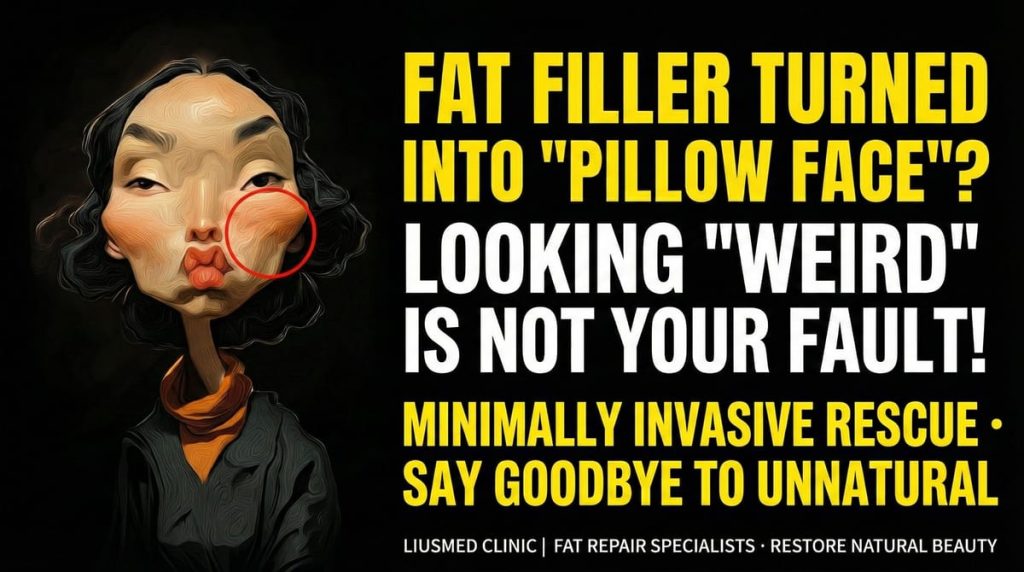
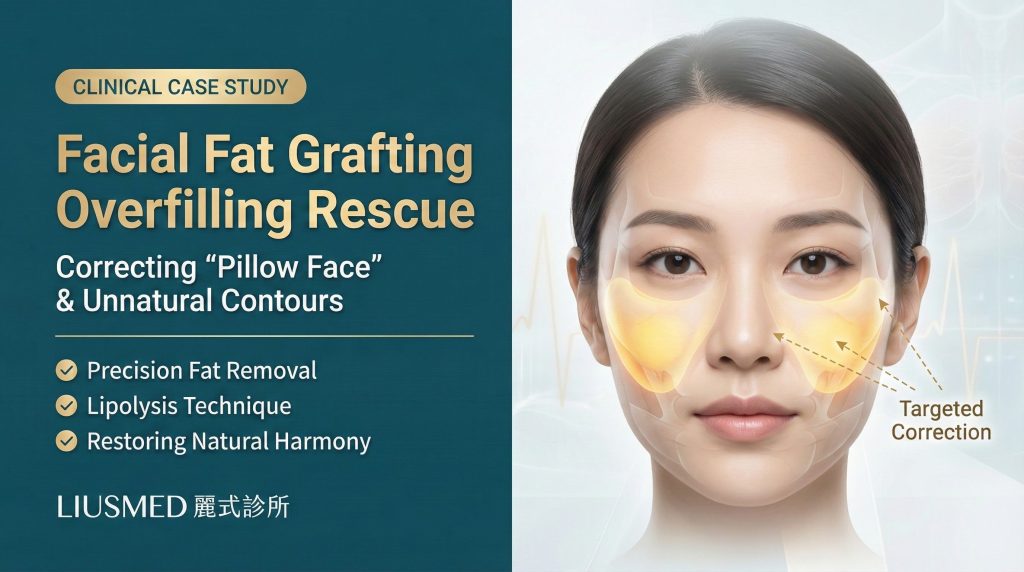
A "pillow face" after fat grafting is usually related to how much was injected and at what depth, not just to an individual’s physical constitution.
-
Transplanted fat needs to establish a blood supply to survive, but how much of it remains varies from person to person; passing the 3- to 6-month mark does not guarantee that the volume will no longer change.
-
Overfilling and injecting into incorrect anatomical planes are the two primary culprits behind unnatural-looking autologous fat transfer results.
-
Minimally invasive removal through a pinhole of about 2 mm aims to restore natural facial contours.
-
Provided the technique is precise, fat remains an excellent filler material—the key lies in administering the correct dosage at the proper tissue level.
Introduction: When "Getting Beautiful" Turns into "Getting Swollen"
In this era of widespread cosmetic injectables, many people fall into the "filler trap" in their pursuit of a plump, youthful look. The sweet "apple cheeks" they desired turn into a stiff "pillow face"; delicate contours become overfilled and puffy. Unnatural smiles or even morning facial swelling (Malar Edema) appear. This isn’t just an aesthetic issue; medically, this is known as Facial Overfilled Syndrome (FOS).
If you are looking in the mirror and feeling anxious, please take a deep breath first. You are not alone, and this is something that can be treated.
Deep Dive: Why Does It Turn into a "Hard Steamed Bun"? Understanding FOS
The anatomy of the mid-face is far more complex than we imagine. It contains not only muscles and fat but also intricate ligaments (like the zygomaticocutaneous ligament) and a rich network of blood vessels. The cause of FOS is usually not just "injecting too much," but also involves:
-
Incorrect Planes and Accumulation: In pursuit of longevity, repeated injections cause old and new fillers to accumulate in the wrong anatomical planes. Especially when large-molecule hyaluronic acid is not injected into the periosteal layer, it easily causes superficial tissues to absorb water and swell.
-
Obstructed Lymphatic Drainage: Excessive fillers compress the fragile micro-lymphatic vessels in the mid-face, blocking tissue fluid drainage and causing "morning edema."
-
Biofilms and Fibrosis: Long-term hard lumps are sometimes more than just filler: bacteria may also form a biofilm on the filler’s surface, triggering an inflammatory response in which the body encapsulates it with fibrous tissue. This is one possible cause, and one reason why hyaluronidase (dissolving injections) alone sometimes doesn’t work well for HA lumps.
Facing FOS Repair: 4 Major Patient Concerns (and Our Answers)
Patients coming to Liusmed Clinic for FOS repair consultations are often full of anxiety. We have compiled the four core questions everyone cares about most, using medical evidence to address your anxiety.
Q1: Am I ruined? (Anxiety)
Answer: Please rest assured, you are not ruined. This is not an irreversible terminal illness, but a known medical complication (FOS). Just as there is medicine for a cold, FOS has clear treatment guidelines. We have seen many severe cases, and with correct medical intervention most of them improve and move back toward a natural look; how much each person improves varies. Please stop blaming yourself and leave the problem to a professional medical team.
Q2: Doctor, will my nerves and blood vessels be accidentally injured during removal? (Sense of Security)
Answer: We use "ultrasound guidance." Because we can see, it helps us locate things precisely, but there are still treatment risks to be aware of. Traditional removal or liposuction surgeries are often performed "blindly," which indeed carries risks. But at Liusmed Clinic, we utilize high-frequency Interventional Ultrasound. This technology gives the doctor "a window beneath the skin" to clearly see the position and depth of the filler, and most importantly—to avoid the infraorbital nerve and facial artery. We precisely remove the target while "looking at the screen," preserving the surrounding normal tissue as much as possible, although the risk of nerve or blood vessel injury cannot be ruled out.
Q3: Will my face sag after dissolving or removing the filler? (Aesthetic Concerns)
Answer: We assess sagging and contour changes after the volume is reduced. This is the reason most people hesitate to seek treatment. We use an "addition after subtraction" strategy:
-
Subtraction: Minimally invasive removal of excess fillers.
-
Addition: Depending on how much laxity remains after volume reduction, we assess whether to add non-invasive tightening or a facelift. While reducing the overfilled look, we aim to preserve your facial lines and tissue support; even so, sagging or hollowing can still occur after volume reduction, and whether further adjustment is needed depends on how you actually recover.
Q4: Why is your clinic different? (Trust)
Answer: Because we understand anatomy, have the advanced equipment, and rely on medical evidence.
-
Understand anatomy: We know exactly why the swelling occurs and where the anatomical planes are.
-
Have equipment: We are equipped with high-end ultrasound devices for visualized treatment.
-
Have technique: We utilize layered treatment and minimally invasive Micro-Dissection, leaving a wound the size of a pinhole.
-
Rely on evidence: Our treatment protocols are based on international medical literature and evidence-based medicine, rejecting pure empiricism based on "feelings."
Liusmed’s Minimally Invasive FOS Removal
For materials that cannot be resolved with hyaluronidase (such as Radiesse, Sculptra, Ellansé, and other collagen stimulators), or hard lumps that have already calcified and fibrosed, "Minimally Invasive Ultrasound-Guided Removal" is one option that can be assessed; whether it suits you depends on the material, its location, and the condition of the tissue.
Through just a tiny pinhole, we use Micro-Dissection to push away adhered nerves and blood vessels, and then crush and suction out the stubborn fibrotic lumps. There is no need for traditional facelift surgery, and no need to worry about long scars.
Conclusion: This is a Luxury Mansion Renovation Project
If our face is compared to a house, past aesthetic medicine is sometimes like rough renovation—using cement (hyaluronic acid) to fill any holes in the wall. As a result of overfilling, the house deformed and its structure was compromised.
The restoration project at Liusmed Clinic is not a simple demolition, but a true luxury mansion renovation: First, we use radar (ultrasound) to detect the pipelines and precisely remove the sludge; then, depending on how much the structure has loosened, we assess whether it needs reinforcing (non-invasive tightening or a facelift); finally, we carefully refinish the walls.
Say goodbye to the pillow face, starting with seeing your true self. We understand your helplessness.
Read the more detailed guide on repairing autologous fat grafting complications.
[Appointment Consultation and Contact Information]
You are welcome to come to Liusmed Clinic for an evaluation. Perhaps we are the ones who can help you.
-
Liusmed Clinic – Focusing on Details, Reshaping Aesthetics
-
Taipei Branch: Section 4, Xinyi Road, Da’an District, Taipei City (Phone: 02-2709-2669)
-
Kaohsiung Branch: Zuoying District, Kaohsiung City (Phone: 07-349-6680)
-
Official Website: https://www.liusmed.com/
-
FOS Repair Specialty Website: www.minimalcutsurgery.com
-
LINE Appointment Consultation: ID @liusmed (or click the link https://lin.ee/dY3wih4)
-
Facebook Fan Page: 劉達儒皮膚專科/美容外科 Dr.Liu’s Aesthetic medicine
(This article is for health education purposes only. Actual treatment results vary by individual. Please be sure to consult a professional physician in person for evaluation.)
Learn how excess fat and contour problems are assessed and repaired
📌 Dealing with Filler Complications or an Overfilled Face?
If hyaluronidase hasn’t worked, your face feels heavier after every injection, or you’re noticing lumps and nodules under the skin — you’re not alone, and it’s not something you have to live with.
Dr. Ta-Ju Liu has built a dedicated resource for filler complication treatment:
🔍 Not sure if it’s overfilling (FOS)? → 60-second FOS Assessment — upload a photo, no appointment needed 👉 https://www.fillerrevision.com/en/fos-assessment
🌐 Complete Filler Revision Resource 👉 https://www.fillerrevision.com/en
🎬 Watch Real Cases on YouTube → Surgical footage, case breakdowns & patient stories — subtitles in EN / 繁中 / 日本語 / 한국어 👉 https://www.youtube.com/@DrLiuFillerRevision
📞 Book a Consultation 👉 https://www.fillerrevision.com/en/contact
International patients welcome. Clinics in Taipei & Kaohsiung, Taiwan.
Dr. Ta-Ju Liu