Key Highlights
- The “doughy face” appearance after fat grafting is almost always a technical issue, rather than an individual’s physical constitution.
- Once the transplanted fat establishes a blood supply (typically within 3 to 6 months), it survives permanently and will not be naturally absorbed by the body.
- Overfilling and injecting into incorrect anatomical planes are the two primary culprits behind unnatural-looking autologous fat transfer results.
- Natural facial contours can be effectively restored through a minimally invasive fat removal procedure utilizing micro-incisions.
- Provided the technique is precise, fat remains an excellent filler material—the key lies in administering the correct dosage at the proper tissue level.
Introduction: When “Getting Beautiful” Turns into “Getting Swollen” In this era of widespread micro-plastic surgery, many people fall into the “filler trap” in their pursuit of a plump, youthful look. The sweet “apple cheeks” they desired turn into a stiff “doughy face” (or pillow face); delicate contours become overfilled and puffy. Unnatural smiles or even morning facial swelling (Malar Edema) appear. This isn’t just an aesthetic issue; medically, this is known as Facial Overfilled Syndrome (FOS). If you are looking in the mirror and feeling anxious, please take a deep breath first. You are not alone, and there is a cure.
Deep Dive: Why Does It Turn into a “Hard Steamed Bun”? Understanding FOS The anatomy of the mid-face is far more complex than we imagine. It contains not only muscles and fat but also intricate ligaments (like the zygomaticocutaneous ligament) and a rich network of blood vessels. The cause of FOS is usually not just “injecting too much,” but also involves:
- Incorrect Planes and Accumulation: In pursuit of longevity, repeated injections cause old and new fillers to accumulate in the wrong anatomical planes. Especially when large-molecule hyaluronic acid is not injected into the periosteal layer, it easily causes superficial tissues to absorb water and swell.
- Obstructed Lymphatic Drainage: Excessive fillers compress the fragile micro-lymphatic vessels in the mid-face, blocking tissue fluid drainage and causing “morning edema.”
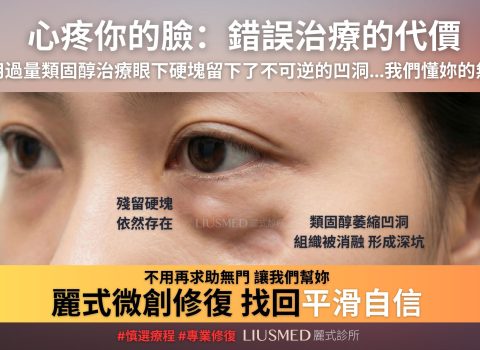
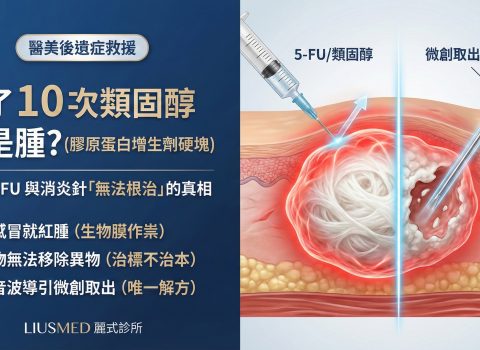
- Biofilms and Fibrosis: Long-term hard lumps are often not just fillers, but biofilms formed by bacteria on the filler’s surface, triggering an inflammatory response in the body that encapsulates them with fibrous tissue. This is why simply injecting hyaluronidase (dissolving injections) is often ineffective.
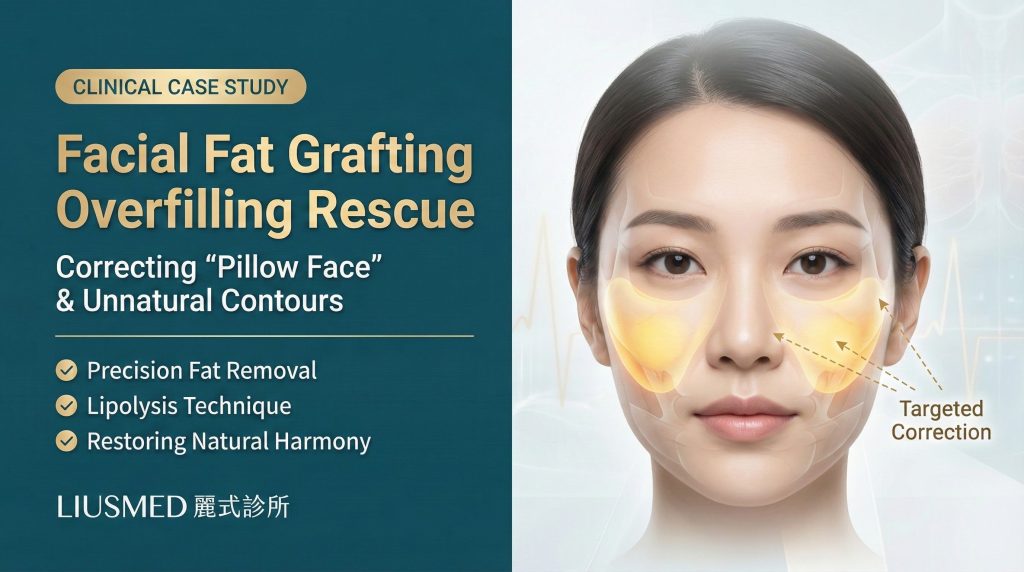
Facing FOS Repair: 4 Major Patient Concerns (and Our Answers) Patients coming to LIUSMED Clinic for FOS repair consultations are often full of anxiety. We have compiled the four core questions everyone cares about most, using medical evidence to address your anxiety.
Q1: Am I ruined? (Anxiety) Answer: Please rest assured, you are not ruined. This is not an irreversible terminal illness, but a known medical complication (FOS). Just as there is medicine for a cold, FOS has clear treatment guidelines. We have seen many severe cases that were successfully restored to a natural state through correct medical intervention. Please stop blaming yourself and leave the problem to a professional medical team.
Q2: Doctor, will my nerves and blood vessels be accidentally injured during removal? (Sense of Security) Answer: We use “ultrasound guidance,” so it is safe because we can see it. Traditional removal or liposuction surgeries are often performed “blindly,” which indeed carries risks. But at LIUSMED Clinic, we utilize high-frequency Interventional Ultrasound. This technology gives the doctor “x-ray vision” to clearly see the position and depth of the filler, and most importantly—to avoid the infraorbital nerve and facial artery. We precisely remove the target object while “looking at the screen,” without harming innocent tissues.
Q3: Will my face sag after dissolving or removing the filler? (Aesthetic Concerns) Answer: We have a “ligament lifting” and “collagen reconstruction” plan, so you won’t sag. This is the reason most people hesitate to seek treatment. The Li-Shi Protocol adopts an “addition after subtraction” strategy:
- Subtraction: Minimally invasive removal of excess fillers.
- Addition: Through “ligament adjustment” techniques and collagen reconstruction treatments, the loose tissues are reattached. We ensure that while removing the overfilled look, the facial lines remain tight and smooth, without turning into a deflated balloon.
Q4: Why is your clinic different? (Trust) Answer: Because we understand anatomy, have the advanced equipment, and rely on medical evidence.
- Understand anatomy: We know exactly why the swelling occurs and where the anatomical planes are.
- Have equipment: We are equipped with high-end ultrasound devices for visualized treatment.
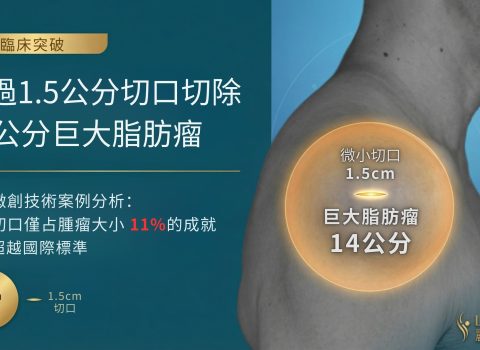
- Have technique: We utilize layered treatment and minimally invasive hydro-dissection techniques, leaving a wound the size of a pinhole.
- Rely on evidence: Our treatment protocols are based on international medical literature and evidence-based medicine, rejecting pure empiricism based on “feelings.”
Li-Style Minimally Invasive FOS Removal: The New Industry Standard For materials that cannot be resolved with hyaluronidase (such as Radiesse, Sculptra, Ellansé, and other collagen stimulators), or hard lumps that have already calcified and fibrosed, the “Minimally Invasive Ultrasound-Guided Removal” is currently the gold standard. Through just a tiny pinhole, we use a special hydro-dissection technique to push away adhered nerves and blood vessels, and then crush and suction out the stubborn fibrotic lumps. There is no need for traditional facelift surgery, nor worry about long scars.
Conclusion: This is a Luxury Mansion Renovation Project If our face is compared to a house, past aesthetic medicine is sometimes like rough renovation—using cement (hyaluronic acid) to fill any holes in the wall. As a result of overfilling, the house deformed and its structure was compromised. The restoration project at LIUSMED Clinic is not a simple demolition, but a true luxury mansion renovation: First, we use radar (ultrasound) to detect the pipelines and precisely remove the sludge; then we re-erect the steel rebars (ligament lifting) to stabilize the structure; finally, we meticulously paint the walls (collagen reconstruction). Say goodbye to the doughy face, starting with seeing your true self. We understand your helplessness.
Read the more detailed authoritative guide on repairing autologous fat grafting complications.
[Appointment Consultation and Contact Information] Welcome to LIUSMED Clinic for an evaluation. Perhaps we are the ones who can help you.
LIUSMED Clinic – Focusing on Details, Reshaping Aesthetics
- Taipei Branch: Section 4, Xinyi Road, Da’an District, Taipei City (Phone: 02-2709-2669)
- Kaohsiung Branch: Zuoying District, Kaohsiung City (Phone: 07-349-6680)
- Official Website: https://www.liusmed.com/
- FOS Repair Specialty Website: www.minimalcutsurgery.com
- LINE Appointment Consultation: ID @liusmed (or click the link https://lin.ee/dY3wih4)
- Facebook Fan Page: 劉達儒皮膚專科/美容外科 Dr.Liu’s Aesthetic medicine
- (This article is for medical educational information. Actual treatment results vary by individual. Please be sure to consult a professional physician in person for evaluation.)
📌 Dealing with Filler Complications or an Overfilled Face?
If hyaluronidase hasn’t worked, your face feels heavier after every injection, or you’re noticing lumps and nodules under the skin — you’re not alone, and it’s not something you have to live with.
Dr. Liu Ta-Ju has built a dedicated resource for filler complication treatment:
🔍 Not sure if it’s overfilling (FOS)?
→ Free 60-second FOS Assessment — upload a photo, no appointment needed
👉 https://fillerrevision.com/fos-assessment
🌐 Complete Filler Revision Resource
👉 https://fillerrevision.com
🎬 Watch Real Cases on YouTube
→ Surgical footage, case breakdowns & patient stories — subtitles in EN / 繁中 / 日本語 / 한국어
👉 https://www.youtube.com/@DrLiuFillerRevision
📞 Book a Consultation
👉 https://fillerrevision.com/contact
International patients welcome. Clinics in Taipei & Kaohsiung, Taiwan.