Introduction: The Hidden Risks Behind the Pursuit of Perfect Tear Troughs
As medical aesthetics becomes increasingly popular, treatments addressing eye aging and tear trough hollows are among the most sought-after procedures. However, the under-eye area, with its thin skin, rich vasculature, and complex anatomical structure, is regarded by many professional physicians as a “high-risk no-fly zone.”
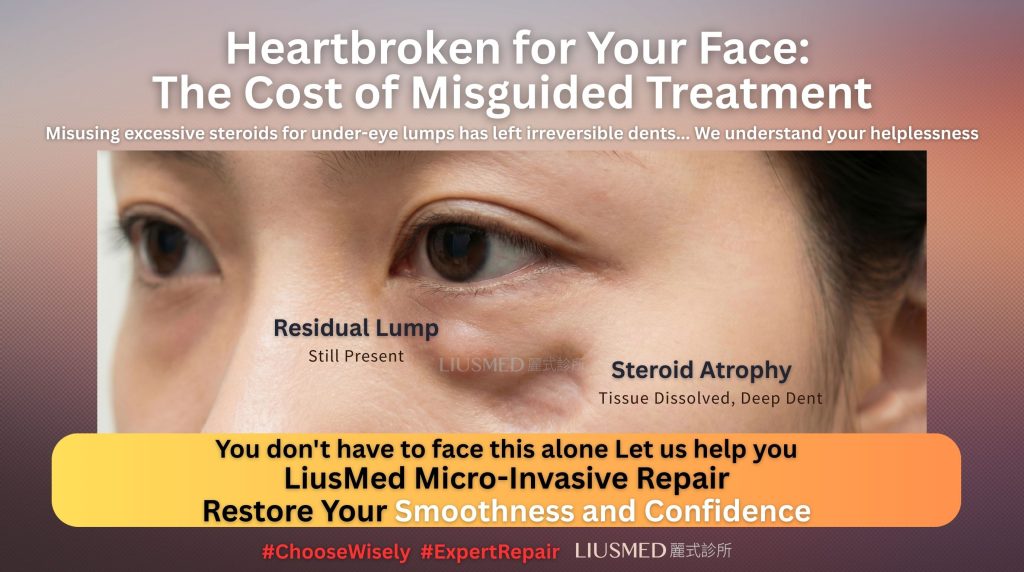
This article provides an in-depth analysis of a heartbreaking real-world clinical case: a patient who chose a collagen stimulator (Ellansé) to improve tear troughs, unfortunately developed nodules, and subsequent steroid treatment to dissolve the lumps led to irreversible “tissue atrophy dents.”
This is not just a review of a single case, but a crucial warning for anyone seeking cosmetic enhancements and for practitioners alike.
Case Presentation
Patient Profile: A young woman with a thin facial structure and minimal subcutaneous fat. She had undergone autologous facial fat grafting a decade ago, which resulted in uneven survival, leaving some areas overfilled while the under-eye tear troughs remained deficient.
Treatment History:
- Initial Procedure: To refine the under-eye hollows, the patient opted for Ellansé injections within the last two to three years.
- Complication Arises: Unfortunately, post-procedure, palpable subcutaneous nodules (lumps) developed in the injected area.
- Misguided Intervention: To eliminate these bothersome lumps, the patient received corticosteroid injections (commonly known as scar-dissolving shots).
- Final Outcome: Shockingly, the target nodules did not disappear. Instead, the steroid medication caused severe atrophy of the normal tissue in the mid-face cheek and tear trough regions. This ultimately left three or four sharply defined, deep dents on her face, resembling indentations made by forceful finger pressure.
In-Depth Analysis: Why Does It Keep Getting Worse?
This case reveals the critical differences in how aesthetic complications are managed. Why did the rescue mission become a disaster?
The Real Risk of Steroid Injection: Blind Injection and Layer Accuracy
We must clarify an important concept: steroid injection itself is not entirely unusable. When used correctly, it is indeed a tool for softening scars and tissue. However, the severe indentation in this case was caused by:
| Root Cause | Explanation |
|---|---|
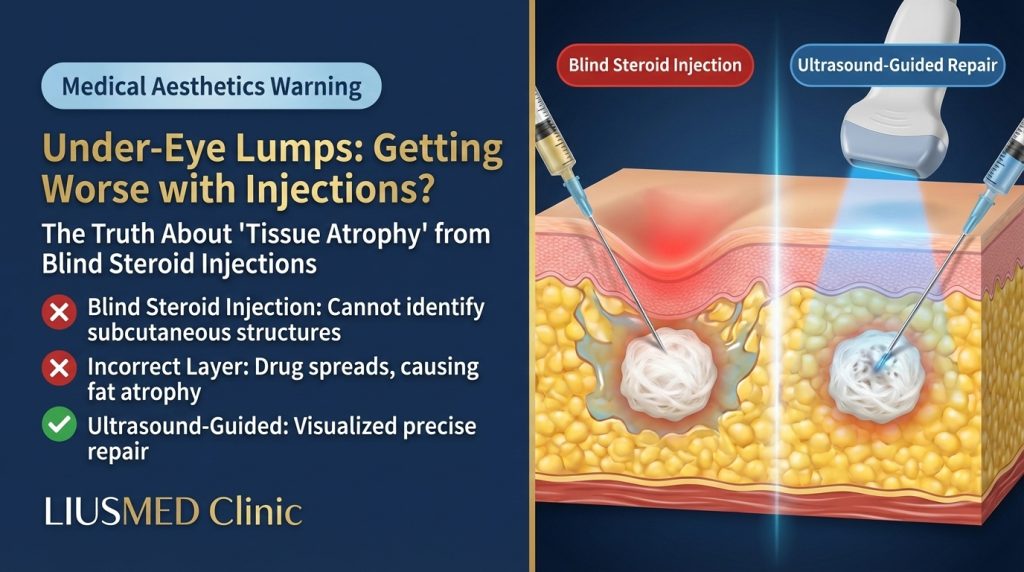
| Lack of Visualization (Blind Injection) | Without real-time guidance from high-frequency soft tissue ultrasound, the physician cannot see subcutaneous structures. It’s like throwing darts blindfolded — nearly impossible to hit the tiny lump core precisely. |
| Incorrect Injection Layer | If the steroid is not precisely injected into the lump core but instead penetrates the surrounding normal subcutaneous fat or dermal layer, it causes normal tissue atrophy. |
| Uncontrolled Dosage | Excessive concentration or volume of steroids causes non-specific tissue destruction, leading to irreversible indentation. |
💡 Conclusion: Steroid injection performed without “visualization” is the primary cause of severe complications. It makes the drug unable to distinguish between “abnormal lumps” and “precious apple cheek tissue,” ultimately leaving behind irreparable deep craters instead of resolving the lumps.
The Risk of Collagen Stimulators Under the Eyes
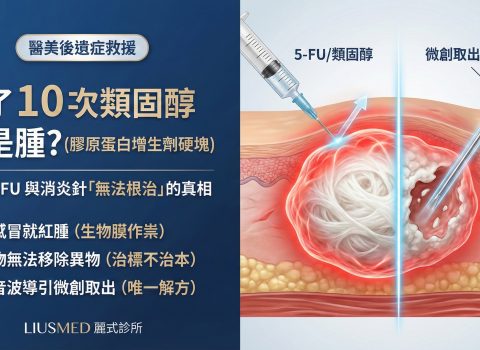
Ellansé’s PCL microspheres stimulate collagen production, but in the extremely thin skin under the eyes, unpredictable excessive proliferation can easily form visible white nodules or lumps. These lumps are extremely difficult to treat (they cannot be dissolved with enzymes), and once formed, patients face the dilemma of “risking atrophy with steroids vs. having no way to dissolve them.”
Doctor’s Perspective: Two Safety Principles and Solutions
Based on these painful lessons, Dr. Liu Ta-Ju of Liusmed Clinic proposes two safety principles to prevent such tragedies at the source:
Principle 1: Choose Safe Materials for the Under-Eye Danger Zone
The periorbital tear trough area has complex structures and thin skin. We strongly recommend prioritizing safe, degradable hyaluronic acid (HA) products.
| Advantage | Explanation |
|---|---|
| Reversibility | This is HA’s greatest advantage. If dissatisfaction or lumps occur, hyaluronidase can safely dissolve it — a material with a “undo button.” |
| Stability | Quality hyaluronic acid rarely produces unpredictable granulomatous reactions. |
Principle 2: Reject Puffiness! Choose the “Non-Puffy Smooth Tear Trough Injection Technique”
Many people are afraid of hyaluronic acid due to fear of failure or unnatural puffiness (commonly called the “caterpillar effect”). This is not the material’s fault — it depends on the physician’s technique and injection depth.
Our clinic’s “Non-Puffy Smooth Tear Trough Injection Technique”:
| Technical Element | Explanation |
|---|---|
| Deep Bone-Level Support | Mimics youthful bone and soft tissue support by placing hyaluronic acid deep to lift the sunken orbital area. |
| Precise Dosage Control | Avoids excessive filler accumulation in superficial subcutaneous layers, preventing the Tyndall effect (blue discoloration) or edema. |
| Long-lasting Improvement | Effectively smooths tear trough depressions while avoiding under-eye puffiness, restoring natural smoothness to the eye area. |
Frequently Asked Questions (FAQ)
Q1: What should I do if I developed lumps after Ellansé injection?
A1: Do not blindly get steroid injections. Seek a clinic equipped with high-frequency ultrasound. The doctor needs to first confirm the depth, size, and whether it’s a granuloma. For simple nodules, ultrasound-guided micro-injection may be attempted; for stubborn lumps, minimally invasive pinhole extraction surgery may be necessary.
Q2: Will areas indented by steroid injections recover on their own?
A2: Full self-recovery is very difficult. Steroid-induced fat atrophy is usually permanent. Repair typically requires waiting until the tissue stabilizes (approximately 3-6 months), then performing precise filling with autologous fat transfer or hyaluronic acid.
Q3: Why don’t you recommend collagen stimulators for under-eye injection?
A3: Because the risk is uncontrollable. The under-eye skin is the thinnest on the entire face — even the slightest excessive proliferation becomes a visible bump. Combined with the fact that these materials have no dissolving enzyme, once problems occur, the treatment cost is extremely high.
Q4: Will hyaluronic acid tear trough fillers really avoid the “caterpillar” effect?
A4: Technique is the key. As long as the injection layer is correct (primarily deep support) and an appropriately supportive HA formula is selected, superficial accumulation causing the “caterpillar” phenomenon can be avoided. Liusmed Clinic’s “non-puffy technique” was designed precisely for this purpose.
Q5: What is ultrasound-guided injection?
A5: This is a form of visualized medicine. Through the ultrasound screen, the doctor can see subcutaneous blood vessels, nerves, lumps, and needle positions in real time. This ensures medication is precisely injected into the lump rather than leaking to surrounding areas and destroying normal tissue — the gold standard for managing complications.
Q6: Is repairing indentations or lumps painful?
A6: No. We use specialized local anesthesia and pain management techniques. Even when treating complex complications or performing minimally invasive repairs, pain levels are very low, and patients typically tolerate the procedure comfortably.
Book a Consultation
| Location | Phone |
|---|---|
| Taipei | 02-2709-2669 |
| Kaohsiung | 07-349-6680 |
LINE Consultation: @liusmed
Feel free to message us or call to schedule a consultation.
Further Reading
Related Articles
- Collagen Stimulator Lumps Won’t Go Away? The Truth About Minimally Invasive Removal
- Mid-Face Over-Filling Syndrome: The Golden Standard for Diagnosis and Treatment
- Filler Lumps and Puffiness — Rescued by Minimally Invasive Extraction
- Hyaluronic Acid and Collagen Stimulator Lump Extraction Technique
Service Pages
📌 Dealing with Filler Complications or an Overfilled Face?
If hyaluronidase hasn’t worked, your face feels heavier after every injection, or you’re noticing lumps and nodules under the skin — you’re not alone, and it’s not something you have to live with.
Dr. Liu Ta-Ju has built a dedicated resource for filler complication treatment:
🔍 Not sure if it’s overfilling (FOS)?
→ Free 60-second FOS Assessment — upload a photo, no appointment needed
👉 https://fillerrevision.com/fos-assessment
🌐 Complete Filler Revision Resource
👉 https://fillerrevision.com
🎬 Watch Real Cases on YouTube
→ Surgical footage, case breakdowns & patient stories — subtitles in EN / 繁中 / 日本語 / 한국어
👉 https://www.youtube.com/@DrLiuFillerRevision
📞 Book a Consultation
👉 https://fillerrevision.com/contact
International patients welcome. Clinics in Taipei & Kaohsiung, Taiwan.
About the Author
Dr. Liu Ta-Ju
- Current Position: Director of Liusmed Clinic
- Specialties: Aesthetic complication repair (lumps/indentation/puffiness), ultrasound-guided injection, non-puffy tear trough hyaluronic acid injection
- Experience:
- Over 20 years of clinical minimally invasive and injection experience
- Committed to “visualized medicine,” introducing high-frequency ultrasound to eliminate blind injection risks
- Advocates “safe aesthetics,” refusing irreversible materials in high-risk areas
- Philosophy: “Aesthetics should make you beautiful, not give you nightmares. We use ultrasound to see the truth and professional technique to repair regrets.”
🔗