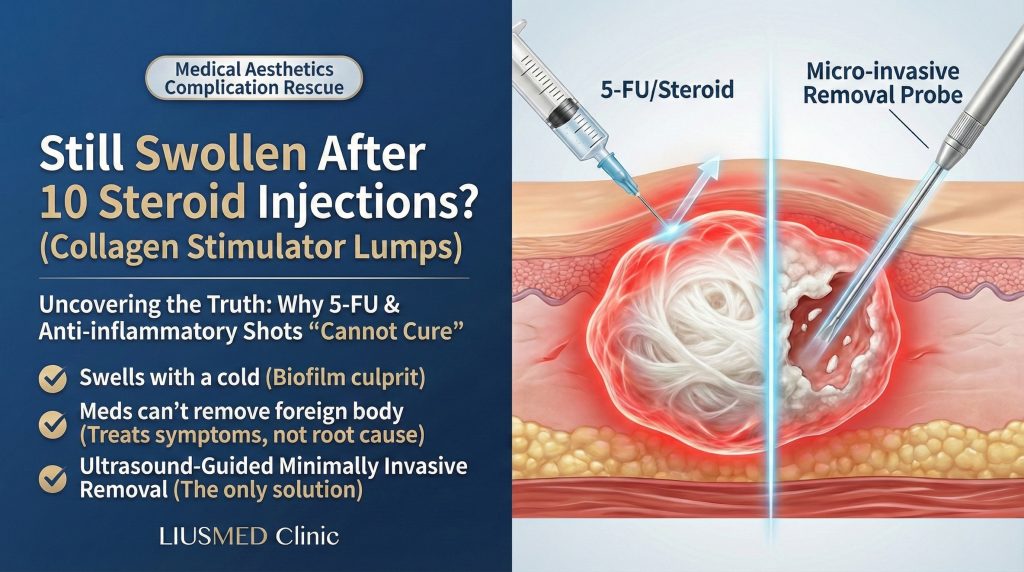
A Journey to Beauty Turns into a Recurring Nightmare?
Recently, a patient arrived at my clinic looking exhausted. Years ago, seeking fuller cheeks, she injected a bottle of collagen stimulator (such as Ellansé, AestheFill, or Sculptra). At first, the results were great, but it soon turned into a nightmare.
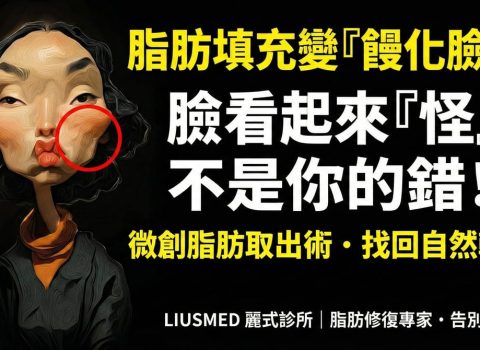
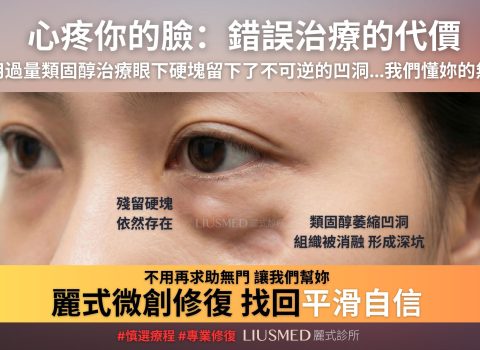
She discovered that whenever she stayed up late, was stressed, or caught a mild cold, her under-eyes and cheeks would swell up like “bread.” Once the swelling subsided, it left behind two palpable, hard nodules.
To eliminate these lumps, she endured severe pain at other clinics, undergoing multiple steroid injections and at least 10 rounds of 5-FU (a chemotherapy drug often used for scars).
“Doctor, it hurts so much. I’ve had so many injections, why are the lumps still there? Why does it swell up every time I get sick?”
This is not an isolated case. It is a shared pain among many patients who have received non-hyaluronic acid fillers. Today, we will analyze from a medical perspective why “more injections” cannot save these lumps and discuss the real solution.
Why Does My Face Swell When I Catch a Cold?
Many patients are told this is just “residual swelling” or “inflammation” that will pass with anti-inflammatory meds. However, it often recurs. In medicine, this is known as Delayed Onset Nodules (DONs).
According to the latest medical research, this is typically related to Biofilms.
The Vicious Cycle of Biofilms
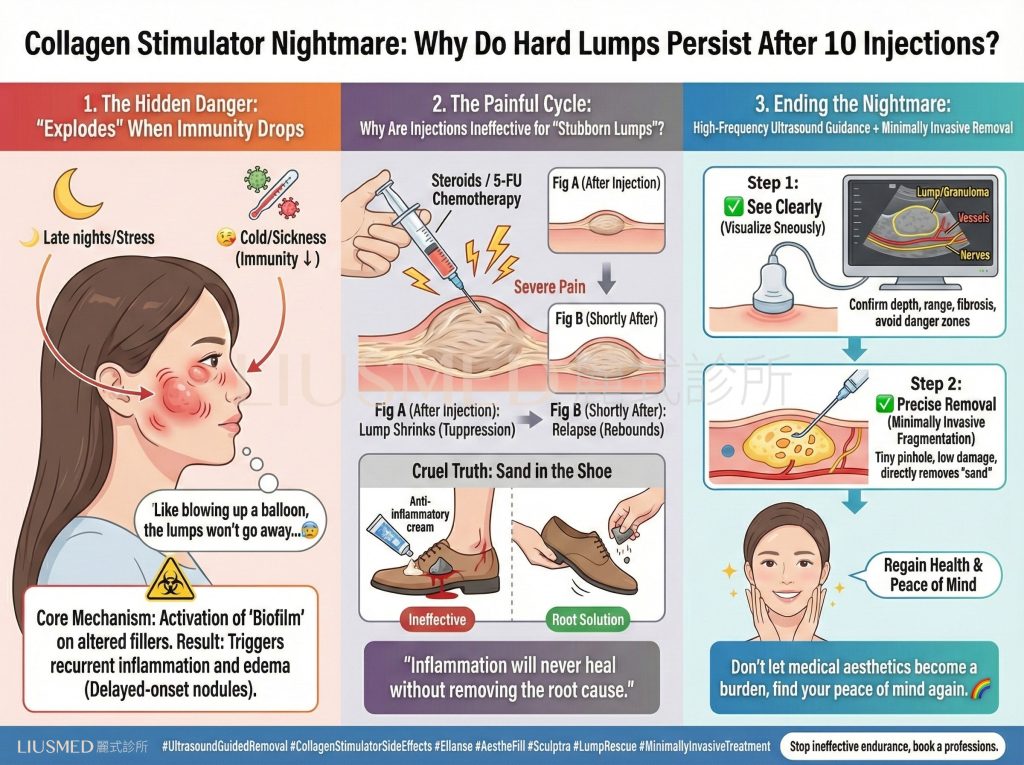
When a filler is injected, bacteria may form a protective layer (biofilm) on the surface of the implant.
| State | Body’s Reaction |
| Normal Immunity | Bacteria are suppressed; no obvious symptoms. |
| Sick/Fatigued | Immunity drops, bacteria become active, triggering an immune attack. |
| Result | Recurring redness, swelling, and heat at the injection site. |
This explains why the patient swelled up “every time she caught a cold”—because the root cause (the filler with the biofilm) was still inside her body.
Why Did 10 Rounds of 5-FU and Steroids Fail?
The standard protocol for treating lumps is often Corticosteroids or 5-FU (5-Fluorouracil, an antimetabolite drug). Literature shows these drugs can inhibit fibroblasts and temporarily shrink granulomas.
However, for stubborn nodules caused by collagen stimulators, simple injections often fail for three reasons:
Three Reasons Why Drug Therapy Fails
| Reason | Explanation |
| 1. Treats Symptoms, Not Root Cause | Drugs thin the “fibrous tissue” wrapping the filler, making the lump feel smaller, but they cannot remove the filler itself (the “core” stimulating the inflammation). |
| 2. Cannot Penetrate Biofilm | If a biofilm has formed, drugs struggle to penetrate it to kill bacteria. Once the drug wears off, the inflammation returns. |
| 3. Risk of Side Effects | Long-term steroid injections can cause tissue atrophy (dents) and spider veins. 5-FU injections are excruciatingly painful (nearly 10/10 pain) and can cause tissue ulcers. |
💡 Dr. Liu Ta-Ju Explains:
“It’s like having sand in your shoe that blisters your foot. You keep applying ointment and painkillers (5-FU), but you never shake the sand out (remove the filler). The foot will never heal.”
The Liusmed Solution: Ultrasound-Guided Minimally Invasive Extraction
Faced with the dilemma of “drugs don’t work, but surgery leaves scars,” Liusmed Clinic utilizes an “Interventional Approach” that bridges the gap between non-invasive procedures and surgery.
(Insert Image: Ultrasound-guided extraction infographic)
Step 1: Ultrasound Guidance — The Medical “X-Ray Vision”
We refuse to treat blindly. Before touching the patient, we use High-Frequency Ultrasound to scan the area:
- Identify Material: Distinguish between Hyaluronic Acid, Collagen Stimulators, or fibrous scar tissue.
- Locate Depth: Determine if the lump is attached to the dermis or buried deep near muscles and vessels.
- Avoid Danger: Precisely map the infraorbital nerve and facial arteries to ensure safety.
Step 2: Pinhole Extraction — Precision Craftsmanship
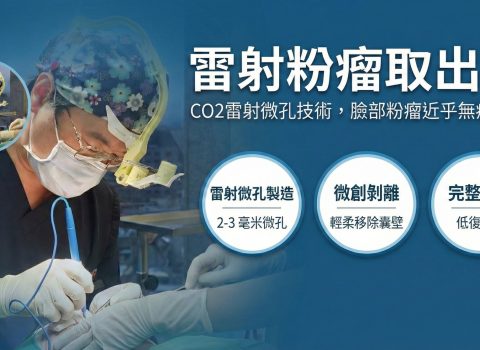
Unlike traditional surgery requiring large incisions, we access the area through a tiny pinhole:
- Hydro-dissection: Using a water jet to separate nerves and vessels from the lump.
- Crushing & Removal: Using specialized instruments to break down calcified lumps or polymer aggregates, followed by negative pressure suction.
Core Value: Removing the Root Cause
The value of this technology is simple: It removes the primary cause of inflammation. Once the foreign body leaves, the recurring immune response naturally stops.
Comparison: Drug Therapy vs. Minimally Invasive Extraction
| Feature | Steroid/5-FU Injections | Ultrasound-Guided Extraction |
| Mechanism | Inhibits inflammation, shrinks fibrosis | Physically removes the foreign body |
| Sessions | Requires multiple repeated injections | Usually resolved in one session |
| Pain Level | 5-FU is extremely painful | Almost painless under local anesthesia |
| Recurrence | High (foreign body remains) | Low (root cause removed) |
| Recovery | Swelling for days after each shot | Swelling subsides in 1-2 weeks |
| Side Effects | Risk of dents, ulcers | Tiny pinhole, minimal scarring |
Frequently Asked Questions (FAQ)
Q1: Can collagen stimulator lumps be dissolved with drugs?
A1: Unlike Hyaluronic Acid, collagen stimulators (Ellansé, AestheFill, Sculptra) cannot be dissolved with an enzyme (Hyaluronidase). Drug therapy only temporarily shrinks the surrounding fibrous tissue but cannot eliminate the filler itself. If repeated injections fail, extraction should be considered.
Q2: Will the extraction surgery leave a scar?
A2: The minimally invasive pinhole technique used at Liusmed Clinic involves a wound usually smaller than 2mm. Post-operative scarring is virtually invisible. In contrast, the skin damage from long-term inflammation or repeated 5-FU injections is often more noticeable.
Q3: Can all collagen stimulator lumps be removed?
A3: Most cases can be successfully treated. However, if the filler is deeply fused with tissue, extremely widespread, or located in high-risk zones (like inside the orbital rim), individual assessment is required, and staged treatment may be necessary.
Q4: Will my cheek look sunken after removal?
A4: There may be a slight depression initially (due to the removal of the foreign body volume), but tissue typically recovers within 3-6 months. If needed, safe Hyaluronic Acid can be used to refill the area once stable.
Q5: What is the recovery time?
A5:
- Day of Surgery: Normal activity possible; avoid strenuous exercise.
- 1-3 Days: Mild swelling; ice packs recommended.
- 1-2 Weeks: Swelling subsides; appearance returns to normal.
Conclusion: Don’t Let the Wrong Treatment Prolong Your Pain
Returning to that patient—after the ultrasound-guided extraction, we removed white granular matter mixed with fibrous tissue from deep within her cheek.
One month later, she told me:
“Doctor, I finally don’t have to worry about catching a cold anymore. The fear that my face might swell up at any moment is finally gone.”
If you are suffering from Ellansé lumps, AestheFill nodules, or recurring facial swelling, please stop the ineffective and painful endurance. “Extraction” may sound intimidating, but under ultrasound guidance, it is actually a safer and more fundamental solution than repeated chemotherapy injections.
Book a Consultation
- Taipei Clinic: 02-2709-2669
- Kaohsiung Clinic: 07-349-6680
- LINE Consultation: @liusmed
Feel free to message or call us to schedule a consultation.
📌 Dealing with Filler Complications or an Overfilled Face?
If hyaluronidase hasn’t worked, your face feels heavier after every injection, or you’re noticing lumps and nodules under the skin — you’re not alone, and it’s not something you have to live with.
Dr. Liu Ta-Ju has built a dedicated resource for filler complication treatment:
🔍 Not sure if it’s overfilling (FOS)?
→ Free 60-second FOS Assessment — upload a photo, no appointment needed
👉 https://fillerrevision.com/fos-assessment
🌐 Complete Filler Revision Resource
👉 https://fillerrevision.com
🎬 Watch Real Cases on YouTube
→ Surgical footage, case breakdowns & patient stories — subtitles in EN / 繁中 / 日本語 / 한국어
👉 https://www.youtube.com/@DrLiuFillerRevision
📞 Book a Consultation
👉 https://fillerrevision.com/contact
International patients welcome. Clinics in Taipei & Kaohsiung, Taiwan.
About the Author
Dr. Liu Ta-Ju (MD)
- Current Position: Director, Liusmed Clinic
- Specialties: Extreme Minimally Invasive Surgery (Lipoma, Cyst), Axillary Hyperhidrosis Surgery, Thread Lifting, Complication Repair.
- Credentials:
- Over 15 years of clinical experience in minimally invasive surgery.
- Over 10,000 successful minimally invasive cases.
- Board Certified Dermatologist (Taiwan).
- Philosophy: “When drug therapy hits a wall, ‘removing the root cause’ is the true solution. We use the smallest wound to remove your biggest burden.”